Building to learn
The dbt Analytics Engineer was on my list of goals for 2026. Along with extensive study of the materials, I wanted to get hands on practice and build a real-world project that maps back to the exam domains.
I picked Formula 1 racing data as the subject, mostly because it's a dataset I find genuinely interesting to work with. Races, drivers, constructors, results, and lap times going back through F1 history, all supplied as CSV files on Kaggle. The project is not trying to model every corner of that dataset. It's about touching as many dbt features as possible to get hands on experinece with the tool.
The goal: a working dbt project where every layer, from sources and seeds through to a contracted mart, maps back to a specific topic on the official dbt Labs study guide.
Infrastructure: Neon, seeds, and sources
The database sits on Neon, a hosted PostgreSQL service, managed day to day through pgAdmin. Connecting dbt
to Neon needs sslmode: require set in the profile, and the project runs in its own Python
virtual environment (Python 3.12.10, dbt-core 1.9.0, dbt-postgres 1.9.0) to keep it isolated from other
projects.
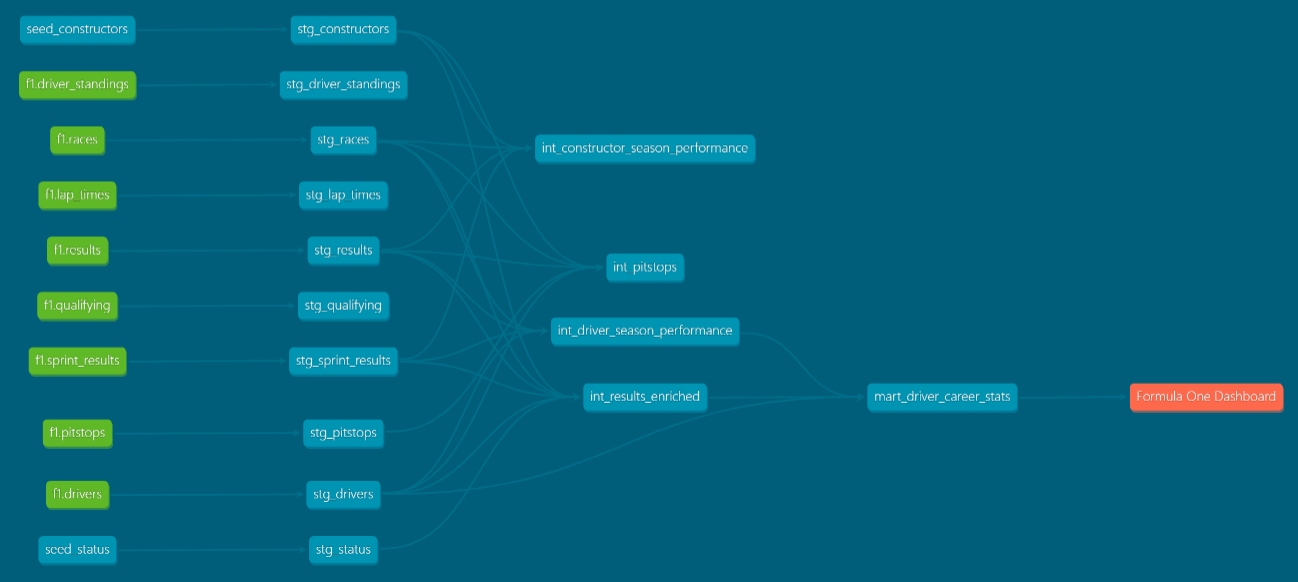
Loading data used a hybrid approach on purpose, since the exam expects an analytics engineer to know when to use each. Large tables, like lap times at over 500,000 rows, were loaded into a raw schema in Neon and declared as dbt sources. Small, static, lookup style tables, like circuits and constructors, went in as seeds instead. Seeds are meant for small reference data, not big transactional tables, and the project follows that distinction deliberately rather than loading everything the same way.
From staging to intermediate: joins and grain
All 13 staging models follow the same two CTE pattern, a source CTE and a
renamed CTE, and all run as views. Casting and renaming happen here. Filtering and business
logic are pushed downstream, with one exception: genuinely broken data can be filtered out at the staging
layer, since that's a data quality problem rather than business logic.
The intermediate layer is where the real modeling work sits. Four models make up this layer.
int_pitstops— a summary model over pit stop data.int_results_enriched— grain of one row per driver per race. Anchored onstg_resultswith left joins out to races, drivers, and constructors. Includes a grid position versus race position comparison, which folded a separate planned model into this one instead of needing its own.int_constructor_season_performance— constructor performance aggregated to season level.int_driver_season_performance— grain of one row per driver per season, built on top ofint_results_enriched.
Grain discipline matters here. Joins at the intermediate layer are left joins anchored on whichever table defines the grain, with everything else pulled in as descriptive detail. That avoids silently dropping or duplicating rows when two tables don't line up cleanly.
Incremental models and raw loading
int_pitstops and int_results_enriched are both materialized as incremental
models, using is_incremental() with incremental_strategy='append'. The staging
models feeding them, stg_pitstops and stg_results, stay as views, since they
only cast and rename. The compute savings from an incremental build matter at the intermediate layer,
where the heavier joins and aggregation actually live.
Growing the raw data itself is a separate job from dbt's incremental logic. A single Python script handles that side, checking the current maximum ID already sitting in Neon for four source tables (pit stops, constructor results, races, and results) and inserting only the rows past that point. Only once new rows exist in the raw table does dbt's own incremental materialization come into play, to avoid reprocessing rows that were already transformed on a prior run.
-- int_results_enriched.sql, incremental logic

select *
from renamed

{% if is_incremental() %}
where result_id > (select max(result_id) from {{ this }})
{% endif %}A silent config failure. The incremental model SQL files originally used
strategy='append' in a config block. The correct property name is
incremental_strategy. The wrong key didn't throw an error, it was just silently ignored.
Fixed by standardizing on schema.yml as the single source of truth for config, and removing
config blocks from the model SQL files entirely.
The mart, and a contract that actually failed once
mart_driver_career_stats is the project's one mart, one row per driver, career to date. It
pulls career wins and podiums from int_driver_season_performance, exact race level dates
(first race, first and last win, first and last podium) from int_results_enriched, date of
birth from stg_drivers, and championship logic joined directly from
stg_driver_standings, since that was judged a one-off aggregation not worth its own
intermediate model.
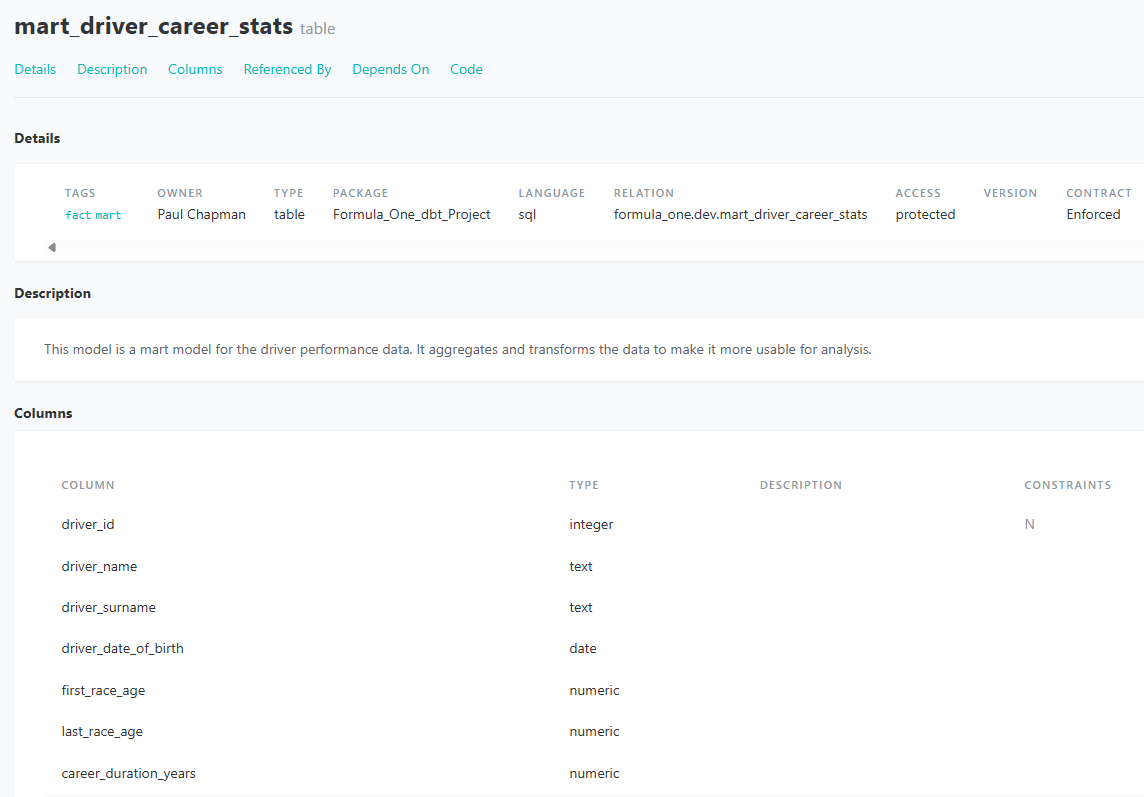
Model governance is the exam domain this mart demonstrates most directly. All 18 columns are declared in
schema.yml with a data_type, the contract is enforced with
contract.enforced: true, and there's a not_null constraint on
driver_id.
The contract caught a real type mismatch. The first contracted build failed.
race_starts, career_wins, career_podiums, and
career_championships_won are built from count() and sum() in
Postgres, which return bigint, not integer, whereas the
contract is declared asinteger. Fixed by casting these columns to integer in the
model SQL, rather than loosening the contract to match whatever Postgres happened to produce.
Tests, tags, groups, and documentation
Generic tests cover the core grain and join integrity checks. unique and
not_null sit on driver_id, race_id, constructor_id,
and result_id across the staging models, and relationships tests confirm
stg_results joins cleanly to both stg_drivers and stg_constructors.
Singular tests, a custom generic test, and the dbt_utils package were all deliberately scoped
out. A duplicate driver-per-race singular test and a non-negative points custom test were both considered
and judged unnecessary against the generic coverage already in place, given the wide-not-deep goal of the
project. Adding a package purely to enable one test is a legitimate thing to skip, not every gap needs a
new dependency closed around it.
All 18 models carry tags for fact versus dimension and staging versus intermediate versus mart, and are
assigned to one of three groups (drivers, constructors, races) through _groups.yml.
Model-level descriptions are set in schema.yml, and dbt docs generate plus
dbt docs serve both run cleanly, with tags and groups showing up correctly in the docs site.
Column-level documentation was deliberately left out, kept at model level only, in keeping with the
wide-not-deep approach.
A real limitation in the source data
Results in this dataset are recorded as at the checkered flag, the moment the race ends. When the FIA
changes a result afterward, for example applying a time penalty that promotes another driver, that change
is never reflected retroactively in results.csv.
A concrete example turned up during the build. Lewis Hamilton finished a race in 7th, and was later
promoted to 6th after Charles Leclerc received a post-race penalty. The source data still shows the
original, pre-penalty positions. That means position, and anything derived from it, like win
counts in int_driver_season_performance or podium counts in
mart_driver_career_stats, reflect race-day classification rather than final official
classification.
There's no field in the dataset showing the corrected result, so no test can catch this. It's documented here as a limitation of the source data, not a bug in the pipeline.
Leveraging dbt state
This domain got a full hands-on pass rather than a quick mention. The workflow: build a baseline manifest,
store it in a state/ directory, then run dbt build --select state:modified --state
state to only rebuild what actually changed.
dbt run --select state:modified --state ./state
dbt build --select state:modified --state ./stateThe --state flag points to a directory, not a file. An early attempt
pointed --state directly at manifest.json, which failed. It needs the
directory containing that file instead.
Testing this further confirmed a distinction that's easy to miss: description-only changes in
schema.yml don't trigger state:modified by default, since that selector tracks
changes to compiled output and config, not documentation metadata. Picking up description changes needs
state:modified.persisted_descriptions instead.
What was deliberately left out
Snapshots were considered for driver_standings or constructor_standings, along
with a computed current-driver flag. Both were scrapped. Snapshots exist to track slowly changing
dimensions on a live, mutable source, and this project's standings tables are historical and load-once,
with no natural row-level change for a snapshot to capture. A current-driver flag is answerable just by
filtering the most recent season, with no change tracking needed. A synthetic workaround, manually editing
rows to fake a change, was considered and rejected as dishonest to the exam prep goal. Better to document
the gap plainly than manufacture a fake use case.
This kind of decision matters as much as the parts that got built. Choosing not to build something, once reasoned through, is different from a gap left by accident, and the project documentation treats both with the same level of detail.
Challenges overcome
A schema mismatch on seed load. dbt seed loaded all four seed tables into
the public schema instead of the intended one. The base schema value in
profiles.yml had been left at public from initial setup. Fixed by changing it
to dev, then rerunning dbt seed --full-refresh to rebuild the tables in the
correct schema.
A config key that looked right but wasn't. The same category of failure showed up
twice in this project. A mismatched seeds key in dbt_project.yml, and later
strategy='append' instead of incremental_strategy='append' in a model config
block. Neither raised an error. Both were just silently ignored, which is arguably worse than a hard
failure, since nothing flags that the setting did nothing.
Personal reflection
This project set out to be a study tool first and a portfolio piece second, and that ordering shaped every decision along the way. Checking the build plan against the official dbt Labs study guide partway through was a useful gut check. It caught that the guide's domain structure had moved from 8 domains to 7, and it surfaced a few real gaps, like macros and Jinja, source freshness, and model versioning, that hadn't been on the radar until then.
The most useful parts of the project ended up being the errors, not the clean runs. The seed schema bug, the silently ignored config key, and the contract catching a real bigint versus integer mismatch all taught more about how dbt actually behaves than the models that worked on the first try.
Next up: building out macros and Jinja with two small hands-on examples, adding an exposure and source freshness checks, and a model version to round out the governance domain alongside the contract already in place.
Questions about this project or the dbt build? Get in touch.
↑ Back to top